Publicity
1. Curriculum Vitae.
I was born and grew up in southwestern Germany, and studied Law and Philosophy at the University of Heidelberg, with minors in Sociology and International Law. Upon completing the coursework for the First State Exam in Law and becoming a PhD candidate in Philosophy, I moved for family reasons to Arizona, where I graduated with a doctoral degree in Law from the University of Arizona. After several decades of practicing business law, I returned to my former passion for exploring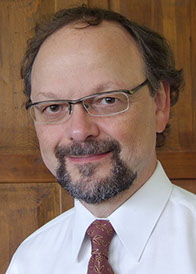 subjects at the intersection of natural and human law and philosophy.
More particularly, my renewed efforts involved two intimately connected aspects of human-centered philosophy: a) Normative Philosophy, the study and application of individual and social human principles, and b) the Philosophy of Happiness, which deals with securing, improving, and optimizing human existence and thriving. Together, these areas of inquiry probe how human affairs can and should be ordered. I had long concluded since my Heidelberg studies that philosophy failed or misled in many of these existential matters, and that a new beginning was required to secure a brighter future.
Back then, I had given up on this because I could not see who would offer such a break. And it never occurred to me until about 2006 that I should give it a try. How this came about is still a mystery to me. I started jotting down a few pages of thoughts without much aim. To my surprise, I quickly found a lot more to revisit and consider. The old nemeses of my former philosophical ambitions, which then had disillusioned me, came back to haunt me. This time, however, I decided to face them head-on. I wrote for seven years, never stalling for material, until I had completed a systematic review of practical philosophy - and a general guide on how one could develop and apply such a philosophy for oneself.
326x244.jpg?crc=434904777 "Labeled Philosophy of Happiness Daisy Meadow") 2. My Philosophy.
2. My Philosophy.
I created a philosophy about obtaining and practicing one's personal philosophy. But why is that important and how did I come to realize this? In hindsight, I can trace how my philosophy is in many respects a product of my Heidelberg days. Dissatisfied with Greek and German Philosophy and other European schools of thought, I used the phenomenal library and institutional depth of this oldest German university to locate and research Chinese, Indian, Mesopotamian, Persian, and Egyptian philosophy. This yielded some valuable insights about interactions between world philosophies. But it also completed my disappointment with the inability of philosophy to describe a coherent system of reality, and constructive agency of humans and humanity in it. Frustration over this had caused me to discount Philosophy as a career choice and turn to the more constructive, practical concerns of Law.
So what changed my mind? My law studies and practice experiences kept confirming that humans can work and agree on mutually beneficial terms of coexistence and cooperation. I think this eventually gave me enough motivation and confidence to revisit and resolve my philosophical frustrations. The result of this labor is a radically, from the ground up new theoretical and practical philosophy focusing on human wellbeing and all that is required for or resulting from it. My philosophy can be summarized as the balance and harmonic advancement of personal existence, humanity, and the non-human environment through the development of individual philosophies. The defining force in this philosophy about philosophy is happiness as an intensely individual but also systematic phenomenon that shapes the human condition and destiny as part of nature. If that is so, it would stand to reason that we can greatly enhance individual and collective human existence if we understand this permeating principle of happiness and place ourselves into its flow. My writings systematically lay out how happiness is the key motivation in existential concerns and dynamics beyond its commonly associated, often trivial connotations. It is the principle by which nature progresses.
3. Readers' Philosophies.
Being part of nature, we are built to abide by it, and bad things happen if we don't. This is readily evident when we look at the misery caused by people's negligence, recklessness, or destructive intent toward themselves or their surroundings. They have turned away from happiness as guiding principle. This truth seems so easy to come by and so important that anybody could and should access it. And yet, its realization is for  many difficult, restricted, or foreclosed. I found exhilarating insights how we can change this, matched by the sobering recognition that change it we must, for our, humanity's, and our world's sake. Witnessing a growing and ever more dire need for systematic practical insight, I have dedicated myself to this purpose.
Toward this goal, I advocate in favor of a reorientation of philosophy onto individuals as sovereign centers of mindful decision-making. And I try to assist readers in reaching and maintaining the necessary authority and self-determination through promotion of their personal philosophies. The essential initiator and mechanism for this is that they perceive, think, and feel for themselves. Persons who grow their own bearings have a better chance to learn how they and their settings function and relate. They are more considerate of themselves, others, and the non-human environment. They are less gullible, timid, or otherwise prone to seek affirmation or leadership from others, or to endure any kind of governance without their consent and participation. Their reflections and actions form the organizational and energetic cores from which the elevation and optimization of the human condition can flow.
Because advancing this is my objective, I am not telling readers what their philosophies should be. I am not even trying to convince them of mine. Rather, I describe common conditions and issues of the human experience for them to reflect on, and I suggest methods for self-realization in both meanings of the word. That individuals make up their own minds, including about what I write and say, is a vital element in this process and the operative underpinning of my philosophy. I trust readers with a healthy mind will find enlightenment and its implementation if they liberate and apply their faculties. The central message of my philosophy is that we each can, should, and have a right to be philosophers of our existence and to take considered charge of our person and circumstances.
4. Public Engagement. 301x169.png?crc=4259642692 "YouTube Video Thumbnail")
I regularly engage with the public on X, Facebook, Instagram, and Bluesky. For more extensive and lasting communications, I am increasingly involved in the Philosophy of Happiness Reddit Community and the Philosophy of Happiness YouTube Channel. See more about this in the Social section of this site. To enable subject-focused interaction that inspires participants to be or become philosophers of their reflected existence, I discuss aspects of my work in a series of videos titled "Public Philosophy Minutes". For details about this initiative, click the Series Preview thumbnail.
The Forum and Blog sections of this website provide additional interaction opportunities for longer contributions.
I also participate in exchanges with scholars, institutions, students, and visitors of the Philosophers on X List, which I curate. See 11.a) in the Resources section for more information on this List.
I am further open to limited appearances, including book signings and interviews. Inquiries can be directed to Palioxis Publishing.
5. Accessing my Work.
All of my philosophical work is freely accessible on this website, through YouTube, and PhilPapers. Please refer to the Resources section for a comprehensive listing. The central expression of my philosophy is the Philosophy of Happiness book. For more information and a review copy, see the Book section. And note the audio book edition, divided by chapters, on this website, paired with corresponding PDF chapter downloads of the text from PhilPapers. The audio version is also available in the subtitled Audio Book playlist on the Philosophy of Happiness YouTube Channel.
Short of reading or listening to the book, this website offers several avenues to get acquainted with the motivations, purposes, and approaches of my work. The book's Table of Contents conveys an initial impression. See 2.a) of the Resources section. Next in line is the FAQ section, which answers 24 questions about my work. And the 10 entries from the Forum section might be looked upon as supplements.
I have also authored a number of articles regarding the development of a personal philosophy. Together with introductions contained in the Philosophy of Happiness book and this website, they are linked in the Intros section. Most of these writings are available in audio format. Two of the introductions have been produced as videos. The thumbnails below link to these directly.

301x170.png?crc=3780948545 "YouTube Video Thumbnail")
300x169.png?crc=3931169374 "YouTube Video Thumbnail")
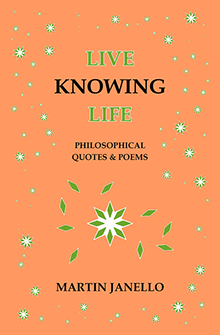
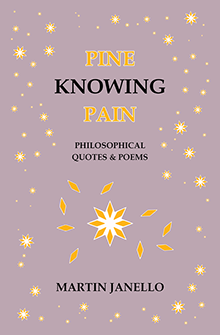
Beyond such more focused sources, I explore topics surrounding, illustrating, or fostering a personal philosophy in articles of the Blog section, essays of the Philosophic Reflections book, and quotes and poems of the 6-part Knowing series of books.
6. Published Books.
Depicted below are book plates of my books. More information about these books can be accessed by clicking on their plates.






Philosophy of
Happiness
E-Book
Philosophic
Reflections
E-Book
Philosophy of
Happiness: A Critical Introduction
E-Book




Use of the images included in this Publicity section is permitted pursuant to the underlined part of the “Electronic Materials Restrictions” clause of the Terms of Use, subject to all other Terms of Use.
Climb Knowing Aim
Paperback and E-Book
Knowing Won't Let Darkness Reign
Paperback and E-Book
© 2013-2026 BY MARTIN JANELLO